A brief history of the Pocket Oxford English Dictionary
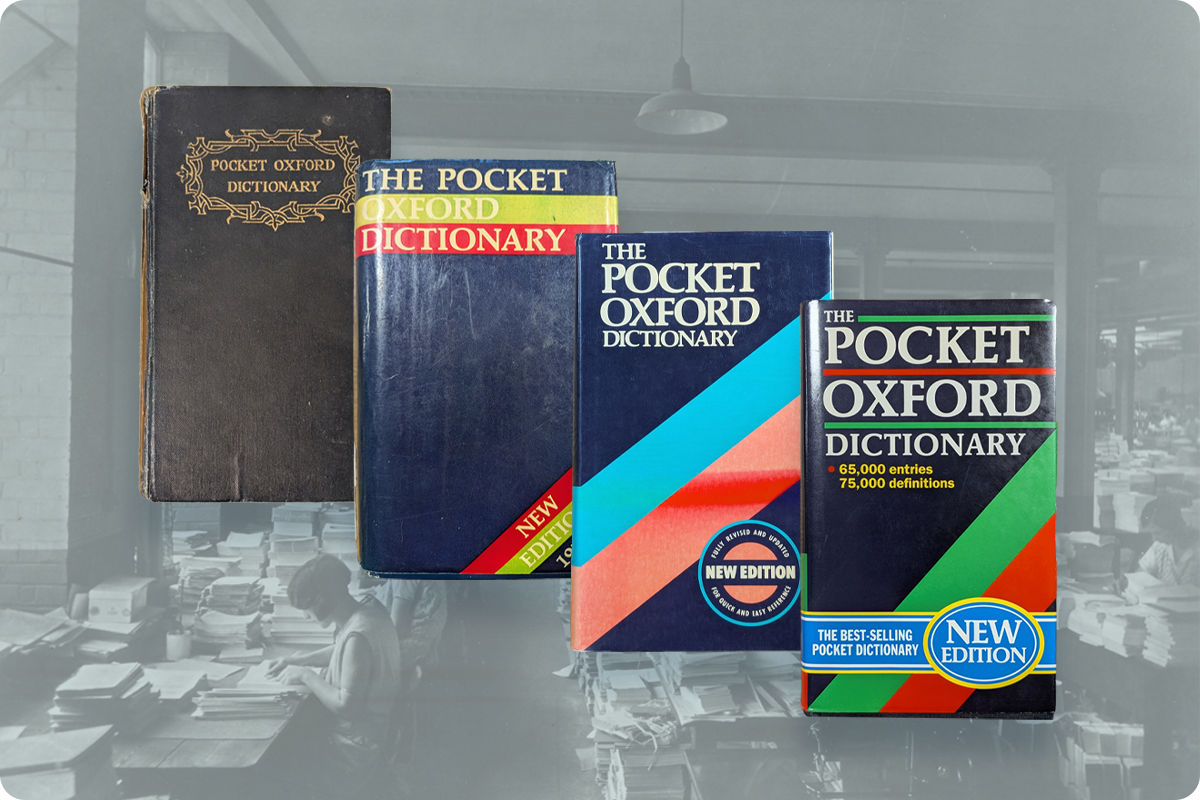
We explore the 115-year history of the Pocket Oxford English Dictionary, from its inception as the ‘shilling dictionary’ to our latest edition that contains over 120,000 words, phrases, and definitions.
Where the Pocket Oxford English Dictionary began
Shortly after the publication of the Concise Oxford Dictionary of Current English (COD) in 1911, work started on what would later become the Pocket Oxford English Dictionary.
Originally referred to as the ‘shilling dictionary’ and the ‘conciser’, it was positioned as a cheaper, abridged version of the COD.
It was edited by the Fowler brothers, Henry and Frank, who aimed to place greater emphasis on pronunciation and sensitivity to American readers.


The first edition arrives
Frank Fowler took the lead on the project, with Henry fatigued by dictionary work following his contributions to the COD. Progress stalled with the outbreak of the First World War, as both brothers were enlisted for service.
Frank died of tuberculosis in May 1918, a few months after writing the dictionary’s preface. Henry continued working on the Pocket Oxford English Dictionary (POD) after his brother’s passing, with the first edition published on 3 July 1924, priced at 3s 6d.
A dictionary through changing times
Henry Fowler passed away in December 1933, having recommended Herbert G. Le Mesurier to succeed him as editor. Le Mesurier oversaw the publication of the second edition in 1934 and the third edition in 1939.
Fourth and fifth editions
Editorship passed to Edward McIntosh, a colleague from the Oxford Dictionary of Modern English, following Le Mesurier’s death in February 1940.
Work continued despite the outbreak of the Second World War, with the fourth edition published in 1942. He also oversaw the fifth edition, published 27 years later in 1969.

Sykes and Allen
We published the sixth edition in 1978, edited by J.B. Sykes (pictured), and the seventh in 1984 under the editorship of R.E. Allen.

Into the 90s
Della Thompson was appointed editor of the eighth edition, which was published in 1992.

The modern-day Pocket Oxford English Dictionary
The POD is now in its 11th edition, which was published in 2013. Informed by the Oxford English Corpus, a database of over two billion words, it covers all the words readers would need for everyday use.
There have also been several foreign editions of the POD since its inception in 1924, including Australian, South African, and Russian-English versions.
More recently, and inspired by the heritage of the Pocket Oxford English Dictionary, JD Sports and BBC Children in Need have released The Youth Club Dictionary, using content from OUP. Working with young people and youth workers across the UK, the dictionary assembles an A-Z list that combines 26 Oxford English Dictionary definitions with the contextual language of youth clubs.
The dictionary comes at a crucial time for youth clubs, with over 1,200 youth clubs closing in the UK since 2010. In their efforts to raise awareness of this, JD and Children in Need launched a charitable campaign focused on protecting the places that speak the language of young people.

Explore more of the OUP Archives and its various collections here.
Related articles